
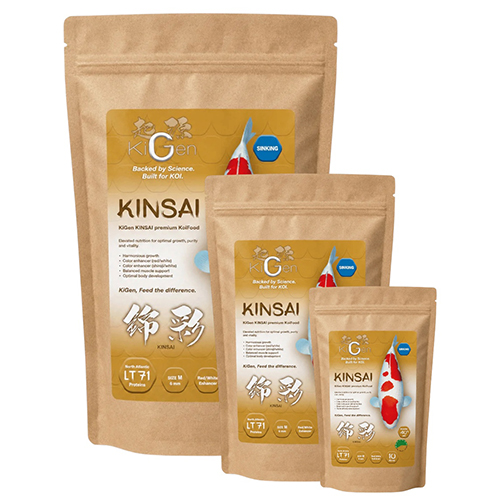
Description
Description (Sinking)
Floating or sinking, the ultimate choice for top-quality koi in peak condition.
KiGen Kinsai Premium Koi Food is a high-grade koi food developed for serious koi keepers who want to support growth, body structure, colour and overall condition. Made using high-quality Arctic fishmeal, salmon oil, spirulina and natural colour-enhancing ingredients, Kinsai is designed to bring out the best in high-quality koi.
Available in both floating and sinking formats, Kinsai gives koi keepers flexibility depending on feeding preference, pond setup and koi behaviour.
Key Benefits
- Supports proportional and balanced growth
- Helps develop beni/red colour
- Supports shiroji/white quality
- Promotes body development without excess fat
- Supports overall health and condition
- Available in floating and sinking versions
Why Choose KiGen Kinsai?
Kinsai is one of KiGen’s premium performance foods, designed for koi keepers who want advanced nutrition without unnecessary fillers. Its balanced protein and fat profile helps koi use nutrients efficiently, while functional additives support resistance, vitality and water quality.
The result is a high-quality food for koi in peak condition.
Product Details
- Pellet Type:Floating or sinking
- Pellet Size:6mm
- Available Sizes:1.2kg, 5kg and 10kg
- Protein 40%
- Best For:Premium koi, growth, colour, body development and conditioning
- Feeding Season:Active feeding periods
Feeding Advice
Feed according to temperature, oxygen levels and filtration capacity. Avoid overfeeding, especially in cooler water or when water quality is unstable.
Feeding recommendation Kinsai koi feed
The feeding levels are intentionally conservative and prioritize
water quality.
Temperature-dependent feeding table
Water Daily feeding ratio
Temperature (% body weight)
< 8°C 0% Do not feed
8–10°C 0.05–0.10% Limited digestion
10–12°C 0.10–0.15% Transition phase
12–14°C 0.15–0.20% Slow digestion
14–16°C 0.20–0.25% Low but stable
16–18°C 0.25–0.30% Upper limit below 18°C
18–20°C 0.30–0.45% Improved utilization
20–22°C 0.45–0.65% Increasing efficiency
22–24°C 0.65–0.90% Approaching optimum
24–26°C 0.90–1.20% Physiological optimum
26–28°C 0.70–0.90% Declining utilization
> 28°C < 0.70% Reduce feeding
A daily feeding ratio of 0.3% of body weight is only reached at
18°C. Feeding rates apply only under optimal conditions (oxygen
supply, filtration, stable water quality). Higher feeding rates do not
guarantee better growth and often lead to reduced water quality.
 Purchase this item and get
Reviews
There are no reviews yet.