
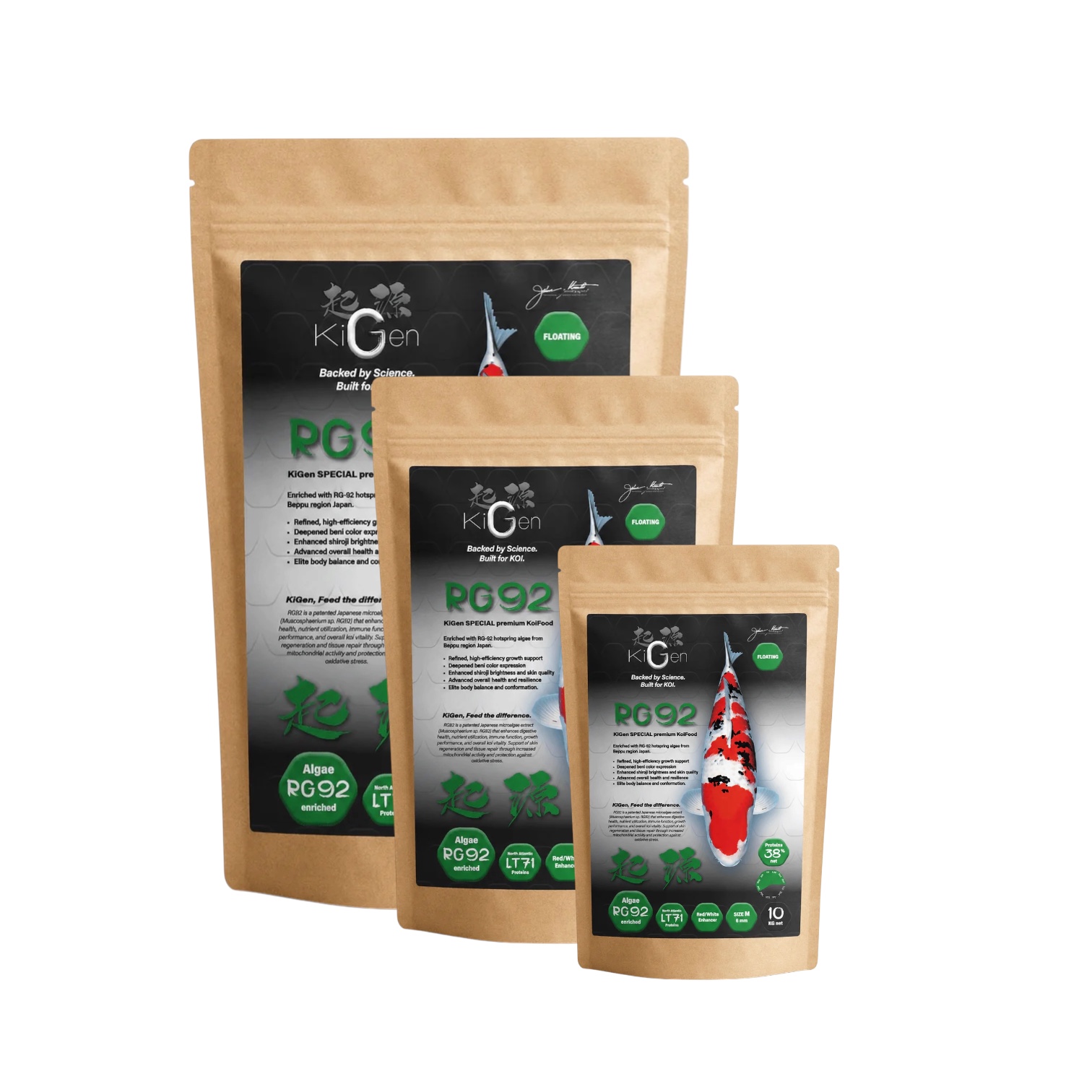
Description
Description (Floating 6mm pellet)
Advanced koi nutrition enriched with RG-92 Beppu hot spring algae.
KiGen RG92 Special Koi Food is the most advanced food in the KiGen range, based on the premium Kinsai formula and enriched with RG-92 Beppu hot spring algae. Developed for koi keepers who want a top-level feed for premium koi, RG92 Special supports growth, colour, body development, vitality and overall condition.
RG-92 is a specialist algae extract used within the formula to provide additional nutritional value and support advanced koi development.
Key Benefits
- Advanced formula enriched with RG-92 algae
- Supports proportional and balanced growth
- Helps develop beni/red colour
- Supports shiroji/white quality
- Promotes overall health and vitality
- Available in floating and sinking versions
Why Choose KiGen RG92 Special?
RG92 Special is designed for serious koi keepers looking for KiGen’s most advanced nutritional option. It builds on the strengths of Kinsai, with the addition of RG-92, a hot spring algae extract that KiGen selected for its potential added value in koi development and vitality.
This makes RG92 Special the ideal choice for high-quality koi, show preparation and serious conditioning programmes.
Product Details
- Pellet Type: Floating or sinking
- Pellet Size: 6mm
- Available Sizes: 1.2kg, 5kg and 10kg
- Protein 40%
- Best For: Premium koi, advanced conditioning, colour, growth and vitality
- Special Ingredient: RG-92 Beppu hot spring algae
Feeding Advice
Feed during active feeding periods and adjust according to temperature, oxygen levels, filtration capacity and water quality. Higher feeding levels should only be used when pond conditions are stable.
Feeding recommendation Marujyu Special koi feed
The feeding levels are intentionally conservative and prioritize
water quality.
Temperature-dependent feeding table
Water Daily feeding ratio
Temperature (% body weight)
< 8°C 0% Do not feed
8–10°C 0.05–0.10% Limited digestion
10–12°C 0.10–0.15% Transition phase
12–14°C 0.15–0.20% Slow digestion
14–16°C 0.20–0.25% Low but stable
16–18°C 0.25–0.30% Upper limit below 18°C
18–20°C 0.30–0.45% Improved utilization
20–22°C 0.45–0.65% Increasing efficiency
22–24°C 0.65–0.90% Approaching optimum
24–26°C 0.90–1.20% Physiological optimum
26–28°C 0.70–0.90% Declining utilization
> 28°C < 0.70% Reduce feeding
A daily feeding ratio of 0.3% of body weight is only reached at
18°C. Feeding rates apply only under optimal conditions (oxygen
supply, filtration, stable water quality). Higher feeding rates do not
guarantee better growth and often lead to reduced water quality.
 Purchase this item and get
Reviews
There are no reviews yet.